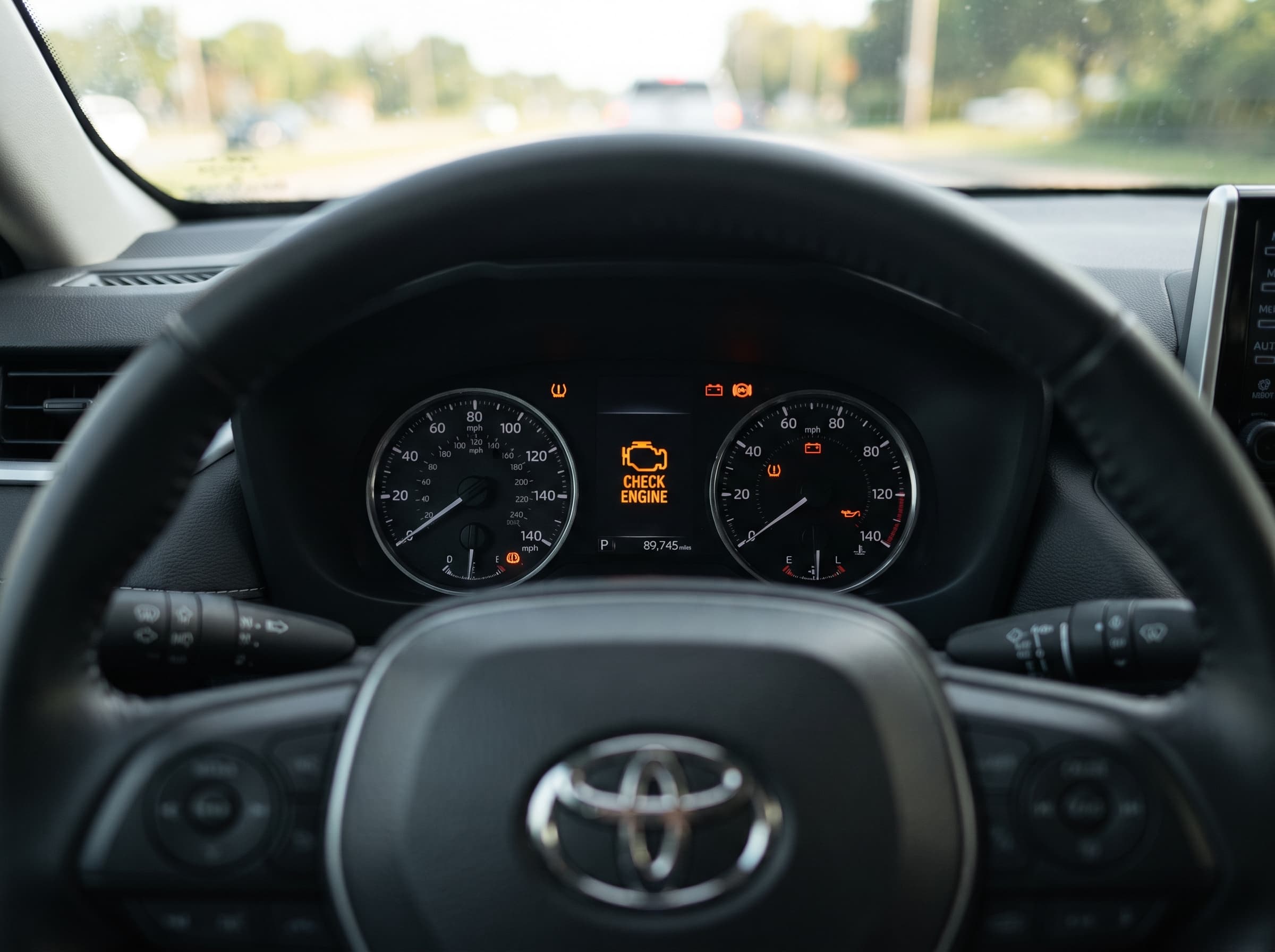
If you're reading this, a warning light probably just lit up on your dashboard and you don't know whether to keep driving or call someone. It's normal to worry. The good news is that it's often not an emergency, but it's not something to ignore either.
The first thing to check is whether the light is steady or flashing: they're not the same. We explain what each one means, why it comes on, and what to do, no mechanical knowledge required.
Steady or flashing? Juan explains it in 15 seconds
What is the check engine light?
Your car has a system that constantly monitors how the engine and the emissions control system are working. When it detects something out of the ordinary, it turns on this light on the dashboard to warn you.
That light, technically called the "Check Engine" light or "MIL" (Malfunction Indicator Lamp, yes, a complicated name), doesn't tell you exactly what's wrong. It only tells you that something is wrong. The detail is stored as an internal code that a mechanic or a diagnostic scanner can read.
Why does it come on? The most common causes
There isn't a single reason. It can be something simple or something that needs attention soon. These are some of the most frequent causes:
A loose or badly closed fuel cap
It sounds silly, but it happens a lot: in many cars, a loose cap turns on the light. If you refueled recently and the light appeared afterwards, tighten the cap until it clicks. The light can take a few days of driving to turn off on its own; if it stays on, have it scanned.
Oxygen sensor
It measures how much oxygen is left in the exhaust so the engine can adjust the air-fuel mixture. If it fails, the car may use more fuel and warns you. It's usually not urgent, but don't let it slide: over time it can damage the catalytic converter, which is far more expensive.
Catalytic converter problems
The catalytic converter reduces the car's emissions. When it starts to fail, the engine light usually comes on, and sometimes you'll notice the car losing power. It's often damaged by another problem that wasn't fixed in time, like a misfire: before replacing it, make sure they find what damaged it.
Faulty ignition coils or worn spark plugs
If the car shakes, struggles to start, or feels like it "stumbles" when accelerating, it could be a spark plug or a coil. In this case it's worth going to the shop soon: they're among the most common causes of a misfire, which is what makes the light flash.
Other sensors
A modern car has many sensors. One incorrect reading is enough to turn on the light. Sometimes the sensor needs to be replaced, but other times the problem is the wiring or connector, or the sensor is fine and is reporting another fault: have it confirmed before replacing it.
Can I keep driving?
It depends on how the light behaves and how the car runs.
You can continue with caution
If the light is steady and the car runs normally (no strange noises, no smoke, no loss of power), it's not an emergency and you can generally keep driving. Still, don't leave it for an indefinite "later": have it scanned soon.
Slow down and go to a shop
If the light flashes, it's most likely a severe misfire, which can damage the catalytic converter. Slow down, avoid hard acceleration, and go to the nearest shop. If it keeps flashing, the car jerks, or it loses power, pull over somewhere safe, turn off the engine, and call a tow truck.
Stop now
If besides the light there's smoke, a burning smell, the car suddenly loses power, or the oil or temperature light comes on (or the needle hits the max), pull over somewhere safe, turn off the engine, and don't continue until you know what's happening.
What do you do now? Three concrete steps
Look at the context
Is the light steady or flashing? Is the car behaving differently? Did you refuel recently? Those answers already give you a lot of information.
Don't ignore the light
It's not decorative. Your car's diagnostic system detected something real. Letting it slide can turn a minor problem into an expensive one.
Ask before going to the shop
You don't have to walk into the shop knowing nothing. Tell Juan what you see and how the car runs, and get clear guidance: how urgent it is, what it could be, and what to ask the mechanic when you arrive.

“Tell me which light came on, whether it's steady or flashing, and how the car runs. I'll tell you what's most likely, how urgent it is, and what to check.”